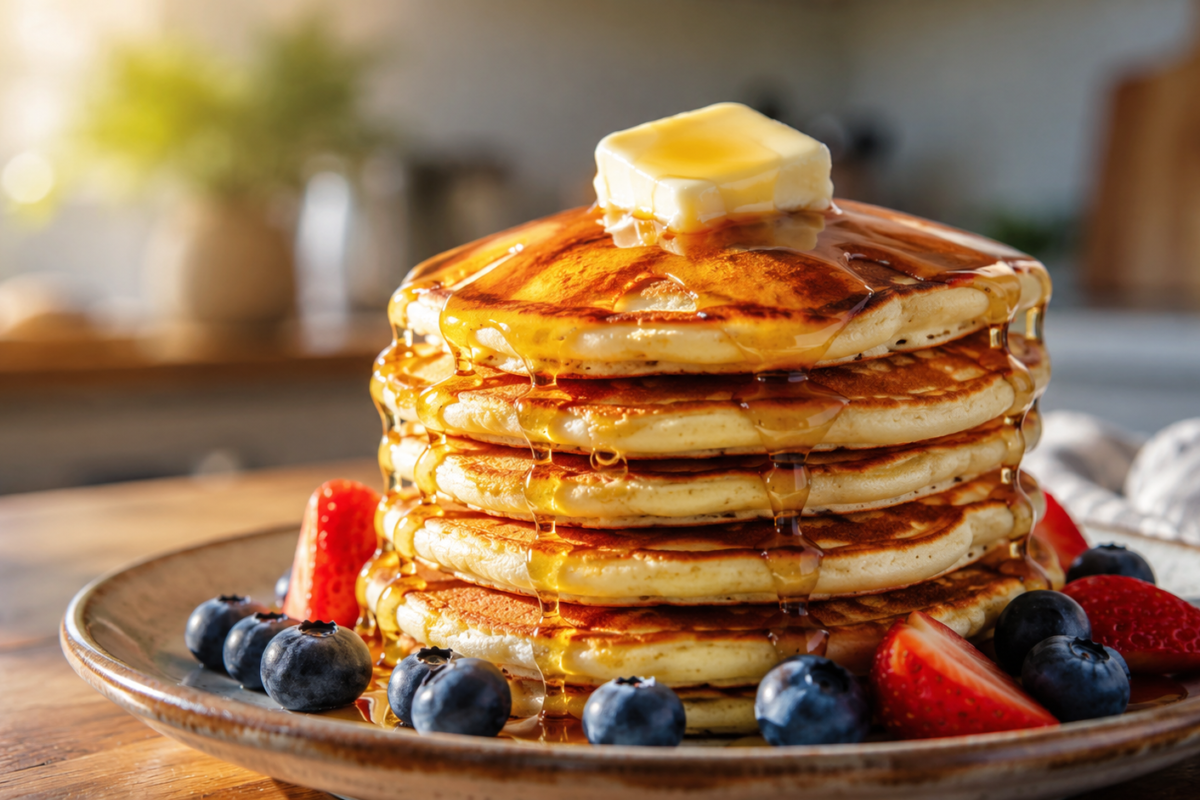
When bright summer mornings arrive across the United States, Canada, and the United Kingdom in June 2026, a tall stack of warm, golden pancakes remains the ultimate comfort food. Many traditional recipes rely heavily on buttermilk to trigger the acid-base reaction required for a dramatic rise. However, running out of buttermilk is one of the most common morning kitchen obstacles. This premium recipe bypasses that issue entirely by utilizing a pantry-stable acid catalyst combination. By pairing standard whole milk with fresh lemon juice and a precise double-acting chemical leavening ratio, these pancakes deliver an incredibly tall, light, and airy texture with a deep vanilla bean aroma—all without needing a trip to the store.
The Chemical Rise Mechanics of Whole Milk Activation
Achieving an exceptionally fluffy pancake texture without thick buttermilk requires creating a controlled, laboratory-style gas release within your batter. This recipe replaces commercial buttermilk by adding fresh lemon juice directly to standard whole milk, creating an instant home-churned acid medium. The citric acid immediately lowers the pH of the milk, causing the dairy proteins to slightly unfold and thicken. When this acidic fluid hits the dry ingredients, it reacts instantaneously with the sodium bicarbonate (baking soda). This primary reaction releases a massive initial wave of carbon dioxide gas bubbles right inside the mixing bowl, micro-aerating the raw batter before it ever touches the heat.
Thermal Expansion and Gluten Regulation
The true structural magic happens the moment the aerated batter hits a hot, ungreased non-stick skillet. This recipe utilizes a double-acting leavening system, meaning a secondary heat-activated acid within the baking powder triggers a second release of carbon dioxide gas when temperatures cross 140 degrees Fahrenheit. As these gas bubbles expand rapidly from the internal heat, they push against a highly delicate, low-gluten flour framework. By using standard all-purpose flour and mixing the batter just until the dry pockets disappear, gluten development is kept to an absolute minimum. This ensures the expanding gas pockets remain trapped within soft, tender walls rather than tough, rubbery strands, producing a melt-in-your-mouth crumb.
Maillard Browning and Flavor Preservation
A perfect pancake requires an even, mahogany-gold surface rather than a spotty, scorched exterior. This uniform coloring is driven by the Maillard reaction—a chemical reaction between amino acids and reducing sugars that occurs under dry heat. To optimize this process, this recipe uses a small, precise quantity of white granulated sugar mixed with melted unsalted butter directly within the liquid phase. The melted butter coats the starch particles, acting as an internal thermal conductor that distributes heat evenly across the entire surface of the pancake. Cooking on a medium-low, completely dry non-stick surface allows these sugars to caramelize slowly and uniformly, locking in moisture while showcasing the deep vanilla aromatic top notes.